
Category: Growing Guides, Kitchen Tips | Read time: 9 minutes
Affiliate Disclosure: This post contains affiliate links. If you purchase through them, I may earn a small commission at no extra cost to you. I only recommend products I genuinely use or would use in my own kitchen. Thank you for supporting 30 Minute Bites — it helps me keep the recipes and guides coming!
I want to tell you something that took me an embarrassingly long time to figure out.The freshest, most nutrient-packed microgreens I’ve ever put in a recipe didn’t come from a farmers market, a specialty grocery store, or an expensive delivery service.
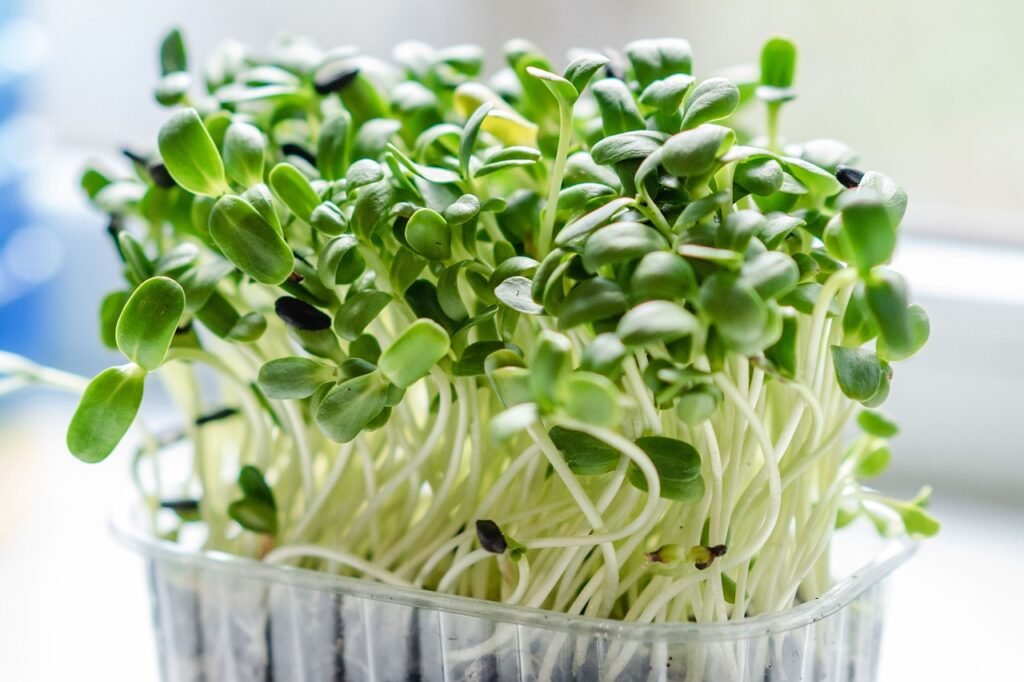
They came from a shallow tray sitting on my kitchen windowsill, next to a half-drunk cup of coffee and a stack of cookbooks I keep meaning to reorganise.Growing microgreens at home is genuinely one of the easiest things you can do in a kitchen.
No garden. No outdoor space. No experience with plants whatsoever. Just a tray, some seeds, water, and about ten days of patience.Once I cracked it, everything changed. I had fresh microgreens available every single week — for smoothies, salads, sandwiches, avocado toast — for a fraction of what I was spending at the store. And honestly? Homegrown microgreens taste noticeably better. Crisper, more vivid, more flavourful.
There’s no comparison.This guide covers everything you need to start your first tray today, even if you’ve killed every plant you’ve ever owned.
What Exactly Are Microgreens?
Before we get into the how, it helps to understand the what — because microgreens are often confused with sprouts, and they’re genuinely different things.
Microgreens are the seedling stage of vegetables and herbs, harvested 7 to 14 days after germination, once the first true leaves have appeared. They grow in a growing medium (soil or a hydroponic mat), they’re snipped above the soil line, and you eat just the stems and leaves.
Sprouts, by contrast, are germinated seeds eaten root and all, usually grown in just water with no growing medium at all. They’re harvested even earlier — often within 3 to 5 days.The distinction matters because microgreens are significantly safer (less risk of bacterial contamination than sprouts), more versatile in cooking, and produce a far better texture for everything from salad toppings to smoothie ingredients.
Popular varieties include sunflower, pea shoots, broccoli, radish, arugula, beet, kale, basil, and amaranth. Each has its own flavour profile, growing time, and best culinary use. We’ll cover that in detail below.
Why Grow Your Own? (The Real Maths)
Here’s the number that convinced me to start:
A 50g punnet of microgreens at a well-stocked supermarket typically costs between $4 and $8. That’s one serving for a salad, or maybe two smoothies.
A bag of sunflower microgreen seeds — enough to grow 8 to 10 trays — costs about $6 to $10.If you harvest once every 10 days, that’s roughly 36 harvests per year from a single bag of seeds.
At store prices, you’d spend $144 to $288 per year on the same amount of microgreens. The seeds cost you $10.The maths isn’t subtle. Home growing pays for itself in the first month.
Beyond cost, there’s the quality argument. Supermarket microgreens are cut up to a week before you buy them, then sit in refrigerated transport and storage. Homegrown microgreens are cut minutes before you eat them. That difference in freshness is genuinely visible — in colour, in crunch, and in taste.
What You’ll Need (The Complete Beginner Kit)
The good news: you don’t need much.
Here’s the full list:The Essentials
1. A shallow growing tray
Standard 10×20 inch seedling trays work perfectly. You want something about 1 to 2 inches deep with drainage holes. Reusable plastic trays are ideal — they last for dozens of grows if you clean them properly between batches.
Alternatively, repurposed takeout containers with a few holes punched in the bottom work completely fine.
2. A second tray (no holes) for bottom watering
More on this in the watering section — but having a solid tray underneath your draining tray is the method that will give you the best, most even growth.
3. A growing medium
You have two main options:Potting mix or seed-starting soil — the easiest for beginners. Use a fine, well-draining mix.
Avoid anything with large bark chips or heavy compost.Hemp or coco coir mats — a cleaner, soilless option that sits flat in the tray and requires no potting mess. Slightly more expensive but reusable and mess-free.
4. Seeds
This is the most important variable. Buy seeds specifically sold for microgreens — not regular garden seeds, and never treated or coated seeds.
Microgreen seeds are sold in larger quantities since you’ll use more than you think. Organic is always preferable.
5.A Spray Bottle
For misting during germination. A simple pump spray bottle costing a dollar or two is absolutely fine.
6. Something to cover the tray
During the germination and blackout phase (the first 3 to 4 days), you need to block all light. An upturned identical tray works perfectly. A sheet of cardboard or a dark plastic bag achieves the same result.
7. A light source
A bright, south-facing windowsill often provides enough light. If your home doesn’t get great natural light, a simple grow light makes a big difference. Even a cheap LED strip positioned 2 to 4 inches above the tray will produce excellent results.
🛒 The One Tool That Makes Everything Easier
If you want to skip the tray-hunting and seed-sourcing and just start growing today, I highly recommend the Back to the Roots Organic Microgreens Grow Kit .It comes with an organic seed mix, a grow tray, growing medium, and clear instructions — everything in one box, ready to go the moment it arrives.
It’s consistently one of the top-rated beginner microgreens kits on Amazon (4.4 stars from thousands of reviews) and currently around $35 , which makes it one of the most affordable ways to get your first successful grow done without fuss.
If you’re unsure whether you’ll love growing microgreens before committing to buying individual supplies, this kit is the perfect low-risk starting point.
The Best Microgreens for Beginners
Not all varieties are equally forgiving for first-time growers. Here’s my honest guide to which ones to start with and which to work up to:
Start Here (Easiest, Fastest, Most Rewarding)
Sunflower microgreens — My number one recommendation for beginners. They germinate quickly and evenly, grow thick and robust, and produce a mild, nutty flavour with satisfying crunch. Ready to harvest in 8 to 12 days.
These are also the microgreens I use most in the kitchen — they work in everything from a tropical microgreens smoothie to a layered grain bowl.
Pea shoots — Sweet, tender, and almost foolproof. They grow fast, produce a generous harvest, and have zero bitterness. Kids almost universally love them. Ready in 8 to 12 days.
Broccoli microgreens — A touch slower than sunflower (10 to 14 days) but packed with more nutrition per gram than almost anything else you can grow. Mild at the microgreen stage — nothing like mature broccoli. Excellent for smoothies.
Radish microgreens — The fastest of all. Many growers see harvest-ready radish microgreens in as little as 5 to 7 days. They have a pleasant peppery kick that works beautifully in salads.
Work Up To These
Basil — Slower to germinate and needs more warmth than most. Rewarding once you crack it, but frustrating for a first grow.
Cilantro — Requires soaking and has uneven germination. Worth growing but better as your third or fourth variety.
Wheatgrass — Needs pre-soaking and more precise watering. Great for adding to smoothies but demands a little more attention.
How to Grow Microgreens: Step by Step
Let’s walk through a complete first grow using sunflower microgreens as the example — the most beginner-friendly variety and, in my opinion, the most delicious.
Step 1: Pre-Soak Your Seeds (Sunflower Only)
Larger seeds like sunflower benefit from a 6 to 8 hour pre-soak in cold water before planting. This softens the seed coat and dramatically speeds up germination.
Simply put your seeds in a bowl, cover with water, and leave them overnight.Smaller seeds (broccoli, radish, pea shoots) can go straight into the tray without soaking.
Step 2: Prepare Your Tray and Growing Medium
If using soil, fill your draining tray to about 1 inch deep. Press it down gently so the surface is flat and even — this prevents seeds from pooling in low spots and producing uneven growth.If using a hemp mat, simply lay it flat in the tray and wet it thoroughly before adding seeds.
Step 3: Sow Your Seeds
Spread seeds evenly and densely across the surface. You want good coverage — seeds can touch but shouldn’t be piled on top of each other. For a standard 10×20 tray of sunflower microgreens, you’ll use roughly 1 to 1.5 cups of seeds.Mist lightly with a spray bottle so seeds are damp but not sitting in water.
Step 4: The Blackout Phase (Days 1–4)
Cover your tray with a lid or dark material and stack something heavy on top. This mimics being underground, encourages strong downward root growth, and builds the pressure that gives microgreens their characteristic upright, sturdy stems.
Check daily and mist if the seeds look dry. You want moisture without waterlogging.By day 3 or 4, you’ll see pale yellow sprouts pushing up. That’s your cue to move to the light phase.
Step 5: The Light Phase (Days 4–10+)
Remove the cover and move your tray to a bright windowsill or under your grow light. This is when the magic visibly happens — within 24 hours of light exposure, those pale yellow sprouts turn vivid green as chlorophyll develops.Switch to bottom watering now. Pour water into the solid tray underneath and let the growing medium absorb it from below.
This keeps the leaves and stems dry (preventing mould) and encourages roots to grow downward rather than sitting in surface moisture.Water once or twice a day depending on your environment — more in warm, dry conditions, less in cool or humid ones.
Step 6: Harvest
Your microgreens are ready to harvest when they reach 2 to 3 inches tall and the seed leaves are fully open. For sunflower, this typically happens between days 8 and 12.Use clean scissors or a sharp knife to cut just above the soil line. Harvest only what you need for that meal — the rest can stay in the tray for another day or two.Rinse your harvest under cold water, spin or pat dry, and use immediately.
The 30 Minute Bites Twist: Grow for What You’ll Actually Cook
Most growing guides treat microgreens as an abstract exercise in indoor gardening. I think about it differently: grow what you’re going to eat this week.
Here’s how I plan my growing schedule around my actual cooking:Sunday evening: Check what’s on the menu for the week. If I’m making a microgreens salad on Wednesday, I want sunflower or pea shoots in the tray by Thursday of the previous week — ready to harvest exactly when I need them.
Rotate two trays. I keep two trays going at all times, staggered 5 to 7 days apart. That way I always have one tray in harvest and one in the blackout phase. No gaps, no scrambling to the store.Match variety to recipe. Broccoli microgreens go straight into my morning smoothie rotation. Sunflower and pea shoots go into salads, wraps, and toast. Radish gets used for anything that needs a peppery bite.
This way, growing microgreens isn’t a hobby that requires planning around your kitchen — it becomes your kitchen planning. You pull from your tray the way someone else opens the fridge. Fresh greens, on demand, every week of the year.
Troubleshooting: The Most Common Problems
Mould on the surface
This is the most common issue beginners face, and it’s almost always caused by overwatering or poor airflow. Switch to bottom watering, reduce how often you water, and if your growing space is particularly humid, a small fan running nearby makes a significant difference.
Also check: is the mould actually mould, or fine white root hairs? Root hairs are normal and appear as delicate fuzzy strands growing from the base of the stem. Mould looks more like a grey or white spiderweb spreading across the soil surface.
Yellowing or pale growth
Microgreens that stay yellow or lime-green after the blackout phase aren’t getting enough light. Move them closer to the window or lower your grow light. True green colour should develop within 24 hours of light exposure.
Leggy, thin, falling-over stems
This means not enough light during the light phase, or the seeds were sown too densely. Both are easily fixed: more light, slightly thinner seed coverage on the next grow.
Uneven germination
Often caused by uneven seed distribution or an uneven soil surface. Press your growing medium flat before sowing, and take time to distribute seeds as evenly as possible.
Seeds not germinating at all
Check your seeds are within date, weren’t stored in a damp or hot place, and aren’t treated or coated garden seeds. Old or improperly stored seeds have dramatically lower germination rates.
Storing Your Harvest
Fresh-cut microgreens are best used immediately — the flavour, texture, and nutrient content are all at their peak the moment you harvest.If you need to store them:Keep unwashed in an airtight container lined with a dry paper towel
Store in the coolest part of your fridge (not the door)
Use within 5 days
Wash only right before using
For smoothies specifically, microgreens can be frozen with surprisingly good results. Portion them into small freezer bags — a smoothie-sized handful per bag — and freeze flat.
Pull one out the night before and add straight to the blender the next morning. I cover this in detail in my microgreens smoothie recipe, including which varieties freeze best.
“Once your microgreens are ready to harvest, the easiest way to use them is as a topper on hearty one pot meals. Try them on our high protein one pot meals for an instant nutrition boost.”
How Much Does It Cost to Grow Your Own?
Let’s break this down properly:
Item Approximate Cost Lasts
Growing trays (set of 2) $8–$12 Years
Potting soil (small bag) $5–$8. 10+grows
Sunflower seed bag. $8–$12 8–12 grows
Spray bottle $2–$4 Years
Total starter cost~$25–$35
Cost per harvest (ongoing)~$0.75–$1.50
Compare that to $4 to $8 per punnet at the store, and the savings are obvious within the first month.If you want the absolute lowest-friction start, the Back to the Roots kit bundles trays, seeds, and growing medium for around $30 to $35 — less than a few punnets from a grocery store.
From Tray to Table: What to Do With Your Harvest
Once your first tray is ready, here’s exactly what to make with it:
That same morning: Add a handful to a tropical microgreens smoothie. Sunflower microgreens blend invisibly into mango, pineapple, and banana — you get the full nutritional hit without changing the flavour at all.
For lunch: Build a microgreens salad using your fresh harvest as the base. Homegrown greens hold their structure better than store-bought, which means your salad stays crisp longer after dressing.
The rest of the week: Pile them onto avocado toast, tuck into sandwiches and wraps, scatter over scrambled eggs, or use as a garnish for soups and grain bowls. The more you grow, the more naturally you’ll reach for them.That’s the real payoff of growing your own — microgreens stop being a special ingredient you buy occasionally and become a kitchen staple you always have available.
Frequently Asked Questions
Do microgreens regrow after cutting?
Most varieties don’t regrow after a single cut — this is normal and expected. Each tray gives you one harvest. Once cut, compost the roots and soil, clean your tray, and start a fresh batch.
How long does a full grow cycle take?
Most beginner varieties are harvest-ready in 7 to 14 days from seeding. Radish is often the fastest at 5 to 7 days. Basil and some herbs can take up to 16 to 21 days.
Can I use regular potting soil?
Yes, with caveats. Choose a fine, well-draining mix with no large bark pieces or heavy compost. Avoid anything marketed for succulents or cacti. Seed-starting mix is ideal.
Do I need a grow light?
Not necessarily. A south-facing window that gets at least 4 to 6 hours of direct or bright indirect light per day is usually sufficient. If your microgreens are consistently leggy or pale despite adequate watering, that’s a signal to add a grow light.
Is it safe to eat microgreens raw?
Yes. Unlike sprouts (which carry a higher contamination risk), microgreens grown in soil or on clean hydroponic mats and harvested above the soil line are very safe to eat raw. Rinse under cold water before eating, as you would any fresh produce.
What’s the best temperature for growing microgreens?
Most varieties thrive between 60°F and 75°F (15°C to 24°C) — basically normal room temperature. Avoid spots next to heating vents (too dry) or draughty windows in winter (too cold).
Can children help grow microgreens?
Absolutely. Microgreens are one of the best beginner growing projects for kids precisely because the results are so fast. Seeing seeds transform into harvestable greens in under two weeks is genuinely exciting for young growers. The peanut butter banana smoothie variation in my smoothie recipe is also a great way to get kids to actually eat what they grew.
Final Thoughts
Growing microgreens at home is one of those rare things that is genuinely easier than it sounds, genuinely cheaper than buying, and genuinely produces a better result than the alternative.
The first tray is the hardest one — not because anything is difficult, but because you don’t yet have the instinct for when to water, when the germination looks right, when they’re ready to harvest. But that instinct comes fast.
By your third or fourth grow, it’s automatic.Start with sunflower or pea shoots. Keep two trays going at once. Grow what you’re going to cook this week.
And if you want the easiest possible entry point, grab the Back to the Roots starter kit — it genuinely removes every barrier between you and your first successful harvest.Your kitchen windowsill is about to earn its keep.
Have you grown microgreens at home before?
Drop a comment below and tell me your favourite variety — I read every single one.
You might also love:
content/uploads/microgreens-step2-tray.jpg” }, { “@type”: “HowToStep”, “position”: 3, “name”: “Sow seeds evenly across the surface”, “text”: “Spread seeds densely and evenly across the growing medium. Seeds can touch but should not pile up. For a standard 10×20 tray of sunflower microgreens use roughly 1 to 1.5 cups of seeds. Mist lightly with a spray bottle.”, “image”: “https://30-minutebites.com/wp-content/uploads/microgreens-step3-sow.jpg” }, {“@type”: “HowToStep”, “position”: 4, “name”: “Cover and begin the blackout phase (Days 1–4)”, “text”: “Cover the tray with a lid or dark material and place something heavy on top to create gentle pressure. This mimics underground conditions and builds strong, upright stems. Check daily and mist if seeds look dry. By day 3 or 4 pale yellow sprouts will appear.”, “image”: “https://30-minutebites.com/wp-content/uploads/microgreens-step4-blackout.jpg” }, { “@type”: “HowToStep”, “position”: 5, “name”: “Expose to light and switch to bottom watering (Days 4–10)”, “text”: “Remove the cover and move to a bright windowsill or under a grow light. Pale sprouts turn vivid green within 24 hours. Switch to bottom watering — pour water into the solid tray underneath and let the growing medium absorb it from below. Water once or twice daily.”, “image”: “https://30-minutebites.com/wp-content/uploads/microgreens-step5-light.jpg” }, { “@type”: “HowToStep”, “position”: 6, “name”: “Harvest when 2 to 3 inches tall”, “text”: “When microgreens reach 2 to 3 inches tall and seed leaves are fully open (typically days 8 to 12 for sunflower), use clean scissors to cut just above the soil line. Harvest only what you need, rinse under cold water, and use immediately for best flavour and nutrition.”, “image”: “https://30-minutebites.com/wp-content/uploads/microgreens-step6-harvest.jpg” } ], “mainEntityOfPage”: { “@type”: “WebPage”, “@id”: “https://30-minutebites.com/how-to-grow-microgreens-at-home/” } }